Skip to content

Digital Equity Champions

Recognizing leadership and excellence in advancing digital equity

About the Digital Equity Champions Awards

Named for Charles Benton, the founder of Benton Institute for Broadband & Society, NDIA created the awards to recognize leadership and dedication in advancing digital equity: from promoting the ideal of accessible and affordable communications technology for all Americans to crafting programs and policies that make it a reality.

NDIA presents two awards: the Digital Equity Champion Award recognizes an outstanding individual who has made a difference in the field of digital equity, while the Digital Equity Emerging Leader Champion Award acknowledges an up-and-coming leader. The awards are presented during the annual NDIA Net Inclusion conference on February 3-5, 2026 in Chicago, Illinois.

Award Criteria

To be successful, nominees should show the following:

1. Sustained Commitment and Expertise in Digital Equity

2. Innovation in Addressing and Solving Digital Inequities

3. Dedication to Serving Targeted Populations

4. Demonstrate Leadership and Collaboration

5. Prioritize Diversity, Equity and Inclusion

6. Use Data to Shape Digital Inclusion Programs

7. Engage in Sustainable and Replicable Work

Scoring & Evaluation

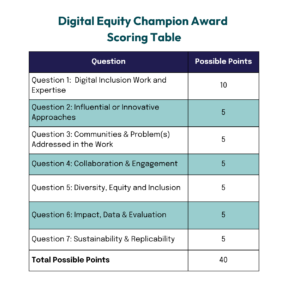
Each nomination is individually scored by members of our selection committee, comprised of previous Digital Equity Champions and community experts. The scoring table provides a breakdown of the points possible for each question. While individual scores contribute to the overall evaluation, the final selection is made by the committee based on a holistic review of each nominee’s contributions to digital equity.

Examples of Strong Nominations

To help you craft a compelling nomination, we’ve included examples of successful nominations from past Digital Equity Champions. See how others have highlighted their nominees’ achievements and gain insight into what makes a strong nomination.

While they offer valuable examples, it’s important to remember that Digital Equity Champions come in all forms! Your unique skills, experiences and approach to digital equity are valuable and could make you the next champion!

Frequently Asked Questions

There are no specific qualifications or credentials necessary for the Digital Equity Champion Awards. We encourage nominations for anyone who has demonstrated leadership and excellence to advancing digital equity. The primary criteria are based on the length of service:

  • Digital Equity Champion Award: Nominees must have at least three (3) years of service in digital inclusion work 
  • Digital Equity Emerging Leader Champion Award: Nominees must have three (3) years or less of service in digital inclusion work 

Additionally, all positions are eligible for nomination. We encourage nominations from individuals across all roles who are working towards digital equity. Previous Digital Equity Champions have held positions such as Digital Inclusion Coordinator and Program Manager, Director of Digital Equity, Head of Strategic Initiatives and Resource Development, and Executive Director. 

Anyone can submit a nomination! You can nominate yourself, or you can nominate someone else who you believe deserves to be recognized as a Digital Equity Champion.

We encourage you to be as detailed as possible when answering all the questions on the nomination form. Providing thorough information helps the selection committee gain a complete understanding of the nominee’s contributions to digital equity. When highlighting the scope of their work, please be specific about the impact they’ve made and the communities they serve. 

To help us better understand the nominee’s work, we encourage you to include links to relevant materials such as blog posts, news articles, recordings of speaking engagements, videos showcasing their work, interviews, etc. 

Tip: Be aware of the different character limits for each answer.

Stay tuned for this year’s nomination deadlines.

The awards are presented annually during the Net Inclusion conference.

Stay tuned for nominee notification dates. We strongly encourage all award recipients to attend the Net Inclusion conference to receive their award in person.

Yes! You are welcome to nominate someone even if they have have been nominated in previous years.

Nominations are submitted online through a Google form. For accessibility purposes, we also offer a PDF version and a Word Doc version of the form. Forms become available when submissions open.

Meet Our Past Champions

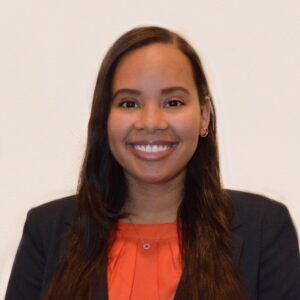
Dr. Mariette Bien-Aime AyalaDirector of Curriculum & Instruction, Tech Goes Home – 2026 Digital Equity Champion, Emerging Leader

As Director of Curriculum and Instruction at Tech Goes Home, she built an entirely new Learning Management System featuring more than 100 modules that were refined through extensive community feedback and organized into eight culturally responsive learning pathways. She has created high-quality, barrier-reducing learning opportunities that meet residents where they are, honor cultural context, and support sustainable skill-building. This new structure has strengthened learner independence, expanded upskilling opportunities, and provided flexible, relevant education for vulnerable and historically marginalized communities. As a result, more than 6,000 Boston learners, primarily immigrants, low-income adults, seniors, and families, have accessed these pathways in the past year. Her leadership has reshaped how Tech Goes Home delivers digital literacy and established a scalable model for equitable, community-driven curriculum design.

Dr. Ayala demonstrates collaborative leadership by actively engaging instructors, community partners, and learners in shaping the curriculum. She led the redesign of the Detroit pilot into a hands-on, collaborative model serving 34 courses and 351 learners. She supervises and mentors staff, co-creates content with community groups, and integrates instructor feedback into curriculum improvement. Her leadership style elevates others and fosters a learning culture in which voices from marginalized communities directly influence the tools created to serve them. Beyond the tech, she is constantly in the community: coaching instructors, co-teaching pop-ups, gathering feedback, and iterating content quickly. This blend of multilingual delivery, flexible access, and community-embedded support is influencing peers and setting a practical standard for inclusive digital learning at scale.
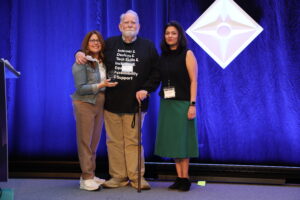
Bill Callahan, Founder and Director of Connect Your Community – 2026 Digital Equity Champion

For nearly 40 years, Bill has been the “Godfather” of the digital inclusion movement, a title earned not just through his longevity in the field but also through his relentless commitment to exposing the structural roots of the digital divide. While many define digital inclusion simply as “access,” he expanded that definition to include “justice” and “accountability”. He fundamentally shifted the national conversation from blaming “non-adopters” to scrutinizing “non-deployers.” By helping lay the groundwork for NDIA and in leading Connect Your Community, he didn’t just build programs; he built the intellectual framework the field now stands on. He is a champion not simply because he leads CYC, but because he has consistently armed communities—no matter the size—with the data and arguments they need to fight for their own connectivity.

His most innovative contribution is the concept of “Digital Redlining.” Before his 2017 co-analysis of AT&T’s network in Cleveland, the digital divide was often framed as a problem of demand (people not wanting internet). He helped flip the script. Using FCC Form 477 and Census data, he proved that major ISPs were systematically excluding poverty-stricken neighborhoods from fiber upgrades, leaving them with slow, expensive copper connections while modernizing wealthy suburbs. This wasn’t just research; it was a novel policy tool that forced regulators and companies to confront their deployment bias. As NDIA’s former Research Director, he standardized how the field uses the American Community Survey (ACS) to measure broadband gaps. He doesn’t just use data for evaluation; he teaches it. His training modules empower local leaders to access and interpret their own community’s data, ensuring that digital inclusion plans are based on facts on the ground rather than assumptions.
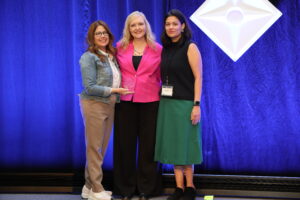
Kami Griffiths, Deputy Director, digitalLIFT

As the founding Executive Director of digitalLIFT (formerly Community Tech Network), she has spent more than two decades building the programs, partnerships, and national momentum needed to advance digital inclusion for those most often left behind. As a leader, she promotes bilingual contract trainers into staff roles and cultivates an inclusive culture where team members share and celebrate their cultures and traditions. Kami recognizes that closing the digital skills gap requires humans working directly with humans, and she has built programs grounded in trust, cultural understanding, and community connection. Through these actions, she models equity-driven leadership and fosters environments where diversity is integral to impact.

Under Kami’s leadership, digitalLIFT has grown from a local Bay Area initiative into a national force serving communities across Texas, California, and scaling services to reach partners nationwide. She pioneered community-based training models, culturally inclusive curriculum, multilingual instruction, and capacity-building programs that empower hundreds of nonprofit and government partners. In 2024 alone, digitalLIFT reached more than 6,000 adult learners, and trained nearly 1,000 trainers from government offices, peer nonprofits, libraries, community health clinics, and the like.
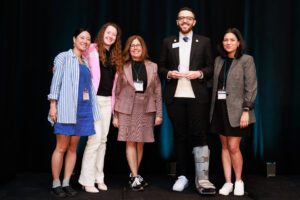
Ibrahim Emara – 2025 Digital Equity Champion Emerging Leader

Ibrahim’s approach to digital inclusion is rooted in accessibility, cultural relevance, and strategic engagement. He co-developed and co-taught Neighborhood Allies (NA) Adult Digital Skills Program, a first-of-its-kind initiative addressing “digital skills deserts” in Pittsburgh and Allegheny County. With the support of the needs assessment Ibrahim is developing a digital skills curriculum for refugees, incorporating Mandarin and his native Arabic to remove language barriers for immigrants. Building capacity and access takes teamwork and dedication, and Ibrahim has worked with the NA team to translate curriculum and focus more on language mapping as a way to better target the needs of underserved communities. Ibrahim created his ‘Beyond Cable’ workshops to further equip residents with knowledge of affordable streaming alternatives, helping households cut the cord.


Kyla Williams Tate – 2025 Digital Equity Champion

Kyla Williams Tate has been a transformative leader in promoting digital equity within Cook County, Illinois. As the inaugural Director of Digital Equity, she spearheaded the creation of the county’s first Digital Equity Action Plan and Digital Equity Map, tools that have been instrumental in advancing the county’s digital inclusion goals. Kyla has led efforts in Cook County to make digital inclusion not just an initiative, but a fundamental part of the community’s fabric. Through her work, Cook County has become a model for digital equity. Under her guidance, Cook County was recognized as a Visionary Digital Inclusion Trailblazer by NDIA in 2023.

Susan Corbett – 2025 Digital Equity Champion

Susan’s approach to digital inclusion involves helping communities build plans and partnerships with the end result of a digital inclusion ecosystem. Susan’s work is predicated on helping each partner and community own and embrace their digital equity plan. As the Executive Director of the National Digital Equity Center, her approach to digital inclusion is best embodied by the NDEC motto: “Partnering to Create Disruptive Strategies to Close the Digital Divide Across the United States”. Throughout the state of Maine and beyond, Susan Corbett guides partners to create the most effective “disruptive strategy” for digital inclusion to make a difference in the lives of those that they serve.

Karimullah Kamwar – 2024 Digital Equity Champion Emerging Leader

Karim brought his wife and five children from Afghanistan to settle in Syracuse. Within one year, he became the manager of the Digital Empower Program with the Syracuse Northeast Community Center. Under his leadership, the Syracuse Northeast Community Center built an inclusive multicultural team including four Digital Navigators. He has integrated this work with other essential services offered through the community center—such as a food pantry, employment program, youth/senior program, and health connections—in order to build true self-reliance.

Norma E. Fernandez – 2024 Digital Equity Champion

Norma joined EveryoneOn in 2013 to increase impact in underserved communities of color by connecting people to the internet. She became CEO in late 2019 and found herself leading EveryoneOn during the COVID-19 pandemic. During this time, she grew and diversified the board and staff, created a strategic framework, and oversaw the implementation of the organization’s first-ever Digital Skills Academy, a training program for individuals and organizations. This has resulted in more funds raised from diverse sources, new partnerships, and expansion in Los Angeles, the Bay Area, and Milwaukee.

Adrienne Pruszynski – 2024 Digital Equity Champion

Adrienne has been a Digital Equity and Inclusion Warrior for more than 15 years, working to close STEM/STEAM equity gaps for youth at the grassroots level from Seattle to Ecuador. She is one of the three founders of Renaissance 21, and is a founder and Program Director of the lead initiative Star Tech Global Academy (STGA). Given difficulties in her journey as a Black woman learning STEM, she sought to empower other underrepresented youth as a STEM teacher. However, she found that programs frequently suffered from lack of resources and infrastructure. In response, Adrienne founded Star Tech Global Academy (STGA) 10 years ago to provide a novel approach to STEM that focuses on digital skills and access for teens.

Read more about the 2024 Digital Equity Champions

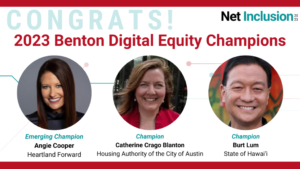
Angie Cooper – 2023 Digital Equity Champion Emerging Leader

Angie Cooper started in the digital equity space in 2020, a jump from her years as a director at Walmart, Inc. She became chief program officer and, most recently in 2023, stepped up as the executive vice president of Heartland Forward, a “think-and-do tank” based in Arkansas and focused on impact in the middle of the country. She launched the Connecting the Heartland initiative to help communities maximize federal broadband and digital equity investments.

Catherine Crago Blanton – 2023 Digital Equity Champion

Catherine has served for more than eight years as the head of strategic initiatives at the Housing Authority of the City of Austin (HACA) and its nonprofit subsidiary Austin Pathways. In 2014, when the agency launched its Unlocking the Connection initiative, about 4 percent of public housing households in Austin were connected to the internet. By 2022, 78 percent of those households were connected. Catherine is a connector and collaborator who values lived experts and emphasizes the need for government services and corporate technology initiatives to weave in digital equity and community expertise.

Burt Lum – 2023 Digital Equity Champion

When someone talks about digital inclusion or broadband in Hawai‘i, the first name mentioned is Burt Lum, state broadband coordinator in the Hawai‘i Broadband and Digital Equity Office. Burt has been a driving force in Hawai‘i technology and telecommunications for nearly four decades, while valuing equity in his work and becoming a driving force for digital inclusion in the state through the Broadband Hui.

Read more about the 2023 Digital Equity Champions

Erica Camacho – 2023 Emerging Leader Winner 

John Torous – 2023 Emerging Leader Winner

For the first time, we named not one, but two emerging leaders – Erica Camacho and John Torous – for their work together on an outstanding digital inclusion project, centered around smartphone-based digital literacy skills for accessing mental health services. Increasing digital literacy, especially for smartphone devices, is critical to ensuring equitable access to mental health services. As COVID-19 has forced so much of mental health online, those unable to connect are excluded from care. As smartphones are the primary tool people use to access digital mental health (video visits and apps) – these programs are designed to directly teach skills and ‘train the trainers’ to offer that teaching.

Tobey Dichter – 2022 Digital Equity Champion 

Tobey Gordon Dichter is founder and chief executive officer of Generations on Line, an award winning national nonprofit dedicated to internet literacy and access for older adults, serving about 200,000 low-income older adults over the past 21 years.

Read more from the Benton Institute

Geoff Millener – 2021 Emerging Leader

Geoff Millener, 2021 Emerging Leader, is the Senior Program and Operations Officer at The Enterprise Center in Chattanooga, Tennessee, which has a growing reputation as one of the best-wired cities in the country. But Geoff realizes that Chattanooga can’t reach its full potential unless it is a digitally equitable city. During the COVID-19 emergency, Geoff collaborated with the University of Tennessee at Chattanooga, Hamilton County Schools, and the municipal broadband provider, The Electric Power Board (EPB), to map out areas with the highest needs and then implement 125 new Wi-Fi access points. He has been a driving force in Hamilton County Schools EdConnect which brought no-cost high-speed internet to 13,000 students’ homes. Geoff has also pushed for the use of data to understand the impact of EdConnect. He is part of a small group collaborating with a research team from Boston College to collect baseline data and monitor how the program impacts education, health and other aspects of life. And he helped to raise more than $8 million to support local digital equity efforts in the last year.

Monica Babine – 2021 Digital Equity Champion

Monica Babine, 2021 Digital Equity Champion, has worked for Washington State University Extension’s Division of Governmental Studies & Services as Senior Associate of the Program for Digital Initiatives. She created the Broadband Action Team model and serves as a valuable resource for local leaders interested in broadband planning. These teams are growing across Washington State, engaging people to identify local digital divides and make plans to bridge them. Recently the State of Washington highlighted Monica’s model as a best practice, and Governor Jay Inslee included funding in his biennial budget to develop a formal statewide program. Monica focuses on rural communities, working tirelessly to bring together citizens that need service with policymakers at the local, state, and federal levels to make ubiquitous broadband access a reality. Monica organized several rural broadband summits in 2019 with the State of Washington and the U.S. Department of Agriculture after the passage of legislation establishing Washington’s Broadband Office and infrastructure program. And Monica was instrumental in providing input to Senator Patty Murray’s staff as they drafted the Digital Equity Act of 2019.

Rebecca F. Kauma – 2020 Digital Equity Champion

Rebecca F. Kauma is a passionate equity-minded digital equity and inclusion leader. In June 2023, she was appointed as the first-ever Director of Digital Equity for the County of Los Angeles. In this inaugural role, she is ensuring that low-income communities and communities of color across the Greater Los Angeles Region have equitable access to and use of digital inclusion opportunities, resources, and power they need to thrive in democracy, society, and the economy. Rebecca strives to uplift and empower communities most in need through equitable, inclusive, and culturally relevant programs, practices, policies, and systems change efforts. She previously served as the first Digital Equity and Inclusion Officer for the City of Long Beach where she led the City’s Digital Inclusion Initiative for five years. In that role, she deployed more than $2.7 million in Federal digital equity grant program funding in collaboration with 11 community partner organizations. This included the administration of free internet connectivity services, technology devices, digital literacy training, and digital inclusion navigation services for Long Beach residents, businesses, and non-profits most impacted by the digital divide during the COVID-19 pandemic.

Daniel Noyes – 2020 Digital Equity Champion

Dan has been involved with TGH since 2002 and on staff since the summer of 2010. After spending several years as a Legislative Aide to a U.S. Congressman in Washington, DC, he returned to Boston as the Technology Director at Fenway High School. In 2006, he was hired by the Lilla G. Frederick Pilot Middle School in Dorchester to help implement the largest middle school 1:1 laptop initiative in New England. Nothing is more important to Dan than his two adorable little girls (and the Sox winning the WS in 2004).

Casey Sorenson – 2019 Digital Equity Champion 

Sorensen has headed PCs for People for over 11 years and crafted a self-sustainable, scalable social enterprise that is a national leader in digital inclusion. Under Sorensen’s leadership, PCs for People has grown from concept to a network of 300 nonprofits, 12 affiliates, and physical offices in three states that are working together to solve the digital divide. As a result of Sorensen’s efforts, over 250,000 people now have home computers and 128,000 people can access the internet in their home. PCs for People is based in St. Paul, Minnesota.

Munirih Jester – 2019 Digital Equity Champion

Munirih Jester serves as the Digital Inclusion ConnectHome Coordinator for the San Antonio Housing Authority (SAHA). Originally from Brazil, Munirih’s professional background is in Public Policy, Nonprofit Management, and Urban and Regional Planning. In her role as ConnectHome Coordinator, she has been able to deliver digital literacy skills training to nearly 2,000 participants, award nearly 900 free computers, and help connect 1,069 homes to the internet.

Read more about the 2019 Digital Equity Champions

Deb Socia – 2018 Digital Equity Champion

Deb serves as the founding Executive Director of Next Century Cities, a national nonprofit that supports community leaders working to secure fast, affordable, and reliable Internet for their localities. With more than 180 members, Next Century Cities brings visibility to broadband issues and informs policy at multiple levels, celebrating local initiative and successes. Before joining NCC, she directed the Tech Goes Home program in Boston, a carefully designed digital equity program that became a national model for linking parents, children and schools to technology resources.

Emy Tseng – 2017 Digital Equity Champion

Since joining the NTIA in 2009, Tseng has worked to increase broadband access and adoption in underserved communities throughout the United States. From 2009 to 2014, she managed a portfolio of local government and K-12 education grants for the Broadband Technology Opportunities Program. She was a major contributor to the Broadband Adoption Toolkit published by NTIA in 2013. She continues her work with NTIA’s BroadbandUSA program providing technical assistance to local and state governments that foster digital equity. Throughout her career, Tseng has demonstrated the ability to combine policy, practice, and data to create a holistic approach to digital inclusion.

Before joining NTIA, Tseng served as the Digital Inclusion Director for the City of San Francisco, where she shaped one of the earliest local government digital inclusion programs and served on the first California State Broadband Task Force. Her work in San Francisco not only promoted computer ownership, digital skills, and Internet access, but also paid special attention to the needs of marginalized communities, showing that it is in the best interest of cities to bridge the digital divide. Tseng additionally served as a fellow at the Berkman Klein Center for Internet and Society at Harvard University, where her work on “inclusive innovation” analyzed how vulnerable communities use, adapt, and shape technology to address their needs and goals.

Tseng’s other experience includes positions as a Senior Policy Advisor at the Community Technology Foundation of California, as a Program Associate for communications policy at the Ford Foundation, and as a software engineer in various technology companies. Ms. Tseng holds a Master’s degree in Technology and Policy from MIT and a Bachelor’s degree in Math/Physics from Brown University.

Read more about the 2017 Digital Equity Champion

David Keyes – Digital Equity Champion

In nearly 20 years of public service in Seattle, David Keyes has used data to document community needs and direct programs, been committed to racial and social justice, and built a movement over time by engaging local elected officials, businesses, education partners, and community organizations in solutions. Seattle recently unveiled a new Digital Equity Action Plan.

NDIA’s Director, Angela Siefer states, “In 1997 David was appointed Seattle’s Community Technology planner and within a couple of years he was a leading figure nationally in the movement we then called “community technology”.  Despite being busy leading the City of Seattle’s model digital equity programs, David continually lends his leadership skills and thoughtful guidance to state and national efforts. NDIA is proud to award David the first Charles Benton Digital Equity Champion Award.”

Read more about the 2016 Digital Equity Champion

For questions relating to the Digital Equity Champions, contact [email protected]