On an afternoon in rural Alabama, a group of seniors gather at their local library, excited for what has become their favorite weekly activity. Some have never touched a computer before, while others had a few stories of frustration with outdated devices. But what united them was a desire to learn—and the patient guidance of Megan Waiters, the lead Digital Navigator for the Community Service Programs of West Alabama (CSP of West Alabama).
CSP of West Alabama, a non-profit organization that has been empowering low-income and vulnerable populations since 1967, was selected to participate in NDIA’s National Digital Navigator Corp program. With support from a Google.org grant, the organization hired a Digital Navigator to provide digital skills training across its ten-county service area. Megan’s experience as a library program director gave her unique insight into the role libraries play in rural communities.
“I knew that libraries would be a good place to build a digital navigator program across ten counties because they are trusted community resource hubs for people to come in and receive hands-on support,” says Megan. “This program is about more than digital skills; it’s about empowering individuals and strengthening communities.”


Digital Navigator Megan Waiters with Jada Bryant receiving a certificate for completing the Digital Skills Challenge.
For Megan, moments like these are the heart of her work. “Every single person who started the class wanted to learn,” she shares. “To see them thrive from having no confidence in the digital space to becoming self-sufficient—it’s incredible.”
CSP of West Alabama’s Digital Navigator program is making waves across its 10-county service area, leveraging libraries as hubs of community engagement. Libraries, Megan says, are “the driving force” behind much of the program’s success. With partnerships secured at 12 libraries and plans to expand further, Megan hosts weekly sessions, helping participants gain digital confidence one step at a time.
The program’s impact is undeniable. Since its launch, CSP of West Alabama has distributed over 560 devices, including laptops and tablets, to residents who completed digital skills training. Many of these devices were tied to the now-expired federal Affordable Connectivity Program (ACP), which Megan helped more than 700 clients navigate and enroll in. Participants not only received devices but also learned the skills needed to use them effectively, such as scanning documents, using email, and accessing online portals.
A highlight of this program is the Digital Skills Challenge, which brings together seniors, families, and other community members for in-person and hybrid classes at libraries across multiple counties. Using Northstar Digital Literacy’s curriculum, Megan guided 76 participants through pre-tests, personalized lessons, and final assessments. Graduates leave with certifications, new devices, and a sense of accomplishment. There’s even a graduation complete with laptops, mousepads, and Bluetooth speakers for the participants.
For some, the journey from digital novice to confident user starts with simple, practical tasks. Megan frequently assists clients with everyday challenges, like scanning documents for housing assistance applications or troubleshooting issues on their devices. “People learn in cycles,” she explains. “They need repetition and real-world application to retain these skills—and technology changes so often, it’s important to keep learning.”
“This Digital Navigator Program has impacted my life tremendously,” says Jessie U., a 68-year-old woman who took one of Megan’s digital skills courses. “The tools I have learned to help me with my computer skills were sharpened by the knowledge I learned through this class. Now I am better equipped to send emails, scan documents, and save important information.”
Megan says that assessing individual skill levels is an important part of creating a Digital Navigator program. “Everyone comes to you with a different skill set – whether it’s computer basics or more advanced knowledge, the digital skills modules are designed to help people at all levels.”
One example of this came recently following a digital skills class. “I took this course believing that I already knew a lot about the use of the computer and smartphone. I just wanted a refresher. Imagine my dismay when my test scores were well below what I expected them to be. I found myself learning a lot of new things, which allowed me to perform tasks the ‘right way’ not the way I had learned through trial and error. My way often involved many unnecessary steps and was time-consuming,” says Barbara W.
Creative initiatives like Digital Bingo have added a fun twist to the learning process. Inspired by the popularity of bingo at senior centers, Megan designed cards listing 24 digital skill activities, such as computer and internet basics, and aligned with the Northstar Digital Literacy program. Following initial pre-assessments on areas regarding basic computer fields, participants can pick an activity that interests them and learn about it. Megan and the library staff are there to assist. Participants who get bingo earn prizes, including devices, tying motivation to tangible rewards.
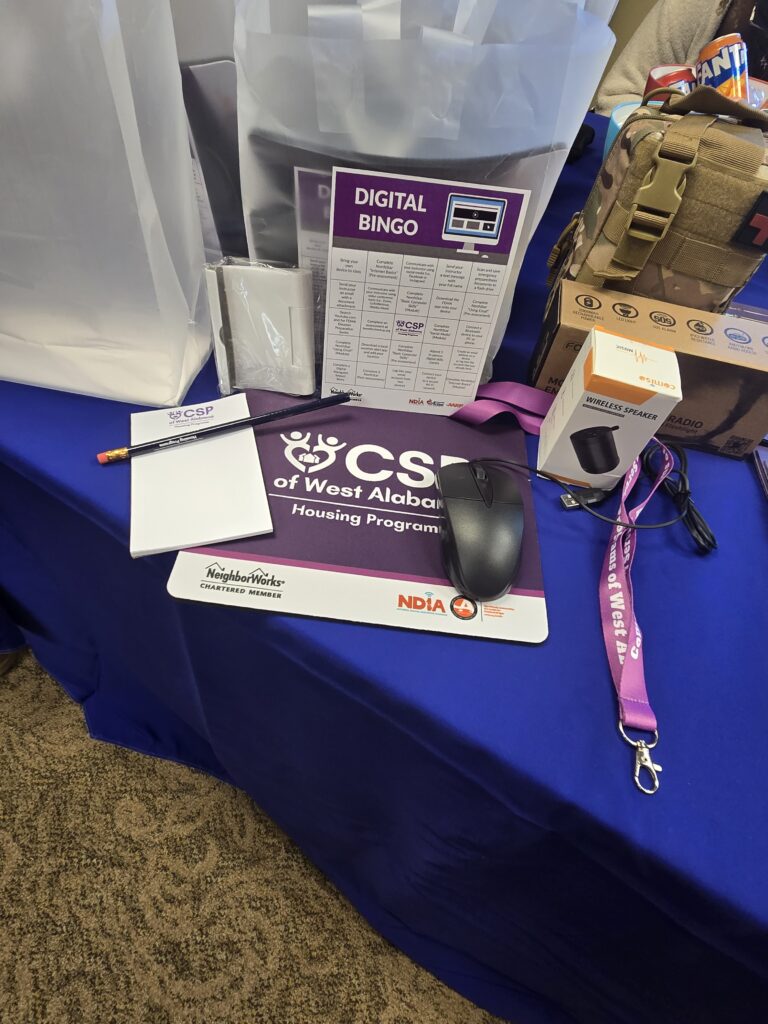
Items for participants at a Digital Skills Challenge: Digital Bingo. Prizes for the first 200 participants included a laptop, mouse, CSP customized mouse pad, lanyard, pencil, and notepad, along with Bluetooth Speaker.
For the first phase of the Digital Skills Challenge, each library location was given a disaster preparedness kit and weather radio. A raffle drawing was also held at each library location, and two winners were chosen to receive either a disaster preparedness kit or a weather radio.
“In all of the navigator lessons, I’ve learned so much more than I thought I was going to learn,” shares Jarmonia T. after taking one of Megan’s workshops. “The impact that the Digital Navigator Program has on me is that I now know more digital skills and the opportunity to receive a free laptop, which can help with everyday needs.”
In addition to foundational skills, Megan incorporates elements like digital disaster preparedness, teaching participants how to scan emergency documents onto flash drives and download essential apps like FEMA’s app that provides tools to stay prepared in a disaster emergency. “If I can teach them how to be proactive, it serves them well,” Megan emphasizes.
The program’s success is a testament to Megan’s dedication and the strong partnerships she’s built, from libraries to housing offices. Looking ahead, Megan hopes to expand her outreach to include students and colleges, bringing digital skills training to even more residents. She also aims to roll out a second phase of the Digital Skills Challenge in additional counties, using community centers to reach areas where library access is limited.
While connectivity in some of Alabama’s Western rural counties remains a challenge—many residents face limited and costly internet options—Megan’s efforts are closing the gap in accessibility, affordability, and adoption. For her, the work is personal. “The need is so great,” she says. “I love what I do.”
Through a combination of passion, perseverance, and community collaboration, CSP of West Alabama’s Digital Navigator program is turning libraries into launching pads for digital empowerment and creating pathways for lifelong learning. For the hundreds of clients who’ve gained skills and confidence, it’s more than just a program—it’s a gateway to new opportunities.

Akron Public Library in Akron, Alabama. Each student received a “Digital Skills Challenge” participation certification.
Increasing Access, Affordability, and Adoption Across West Alabama
- Expanding access to connectivity. Libraries offer free internet access and computers for residents, making them ideal hubs for community engagement. Regular office hours at county libraries have fostered a sustained presence, building relationships that often turn one-time visitors into repeat clients.
- Driving digital adoption through scaled programs. The Digital Bingo Challenge, launched at libraries in Dallas, Greene, Hale, and Sumter counties, engages participants aged 50+ to develop digital skills in a fun and rewarding way. Winners earn prizes such as laptops. In 2025, the program will expand to Bibb, Choctaw, Fayette, Lamar, Perry, and Tuscaloosa counties.
- Equipping people with practical digital skills. Nearly 200 individuals have received assistance through CSP of West Alabama’s Housing Department. This includes first-time homebuyers completing online loan applications, renters scanning and submitting rental agreements, and clients learning to make online monthly rent payments.
This blog was written in collaboration with Raynor Avenue Public Affairs.