For sixty years, the Northwestern Ohio Community Action Commission (NOCAC) has diligently worked to minimize the effects of poverty by doing what it does best—harnessing the power of strong relationships and human connection to link vulnerable individuals to the resources they need. For many of NOCAC’s clients, the capacity to succeed depends largely on their ability to use technology effectively. As such, digital skills training lies at the heart of NOCAC’s efforts.
Under its Financial Opportunity Center initiatives, NOCAC launched its Digital Navigator program three years ago as part of NDIA’s National Digital Navigator Corps and funded by Google.org. Since then, NOCAC has served as a community-based resource guide, helping clients attain digital skills and access affordable devices.
Jamie Huber, NOCAC Community Services Director, is consistently reminded of the importance of building social capital for her clients, and one way NOCAC accomplishes this is by using digital literacy training to connect clients with other community resources. For example, NOCAC partners with financial counselors to give devices to clients who complete the financial literacy curriculum they offer. “Having access to a digital device is akin to having access to drinking water,” she says.
Northwestern Ohio Community Action Commission (NOCAC)’s Digital Navigator Program
- Primarily serves Defiance, Fulton, Henry, Paulding, Van Wert, and Williams Counties
- In 2024, the organization served 132 clients, held 350 sessions, and distributed 56 devices
- NOCAC has active partnerships with eight senior centers, two domestic violence agencies, one low-income apartment complex, and one homeless shelter/soup kitchen

Digital Navigator Joe Burgei works with a member of the NOCAC community.
Joe Burgei, one of NOCAC’s digital navigators, knows this all too well. On any given day, he could be assisting clients at a domestic violence shelter, senior center, or homeless shelter. But wherever he is, he notes the value in witnessing their gratitude and appreciation firsthand. “Whether it’s providing help with a cell phone, computer, or tablet, it’s a privilege to aid our clients in catching up with society.” Joe sees between 4-7 clients daily, roughly 16-28 sessions weekly. His advice for aspiring digital navigators is simple: “Be patient and listen–let them tell their story.”
Joe’s colleague and fellow digital navigator, Megan Hahn, has learned the importance of her clients feeling connected to the outside world, especially to individuals not professionally obligated to assist them. Whether it’s working with the senior population to answer questions they can’t ask their kids or grandkids or assisting women at domestic violence shelters, having a device they can physically own is a monumental comfort to them and often leads to future success. Two of Megan’s female clients, for example, are using their laptops to continue their education, a powerful way to reassert control of their lives.
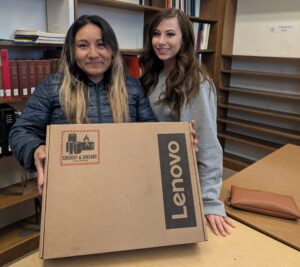
Digital Navigator Megan Hahn distributes a laptop
to an NOCAC community member.
So, what does the future look like for the NOCAC team? They’re keeping their eyes on the Digital Equity Act state capacity subgrants, looking to pursue funding to continue and expand their successful digital navigator program. A new building with a computer lab will be completed soon, and they view the digital navigator program as an integral use of that facility. “There are so many unknowns. When you work in nonprofits, you survive on grant money, but I see firsthand how this particular program can both change lives and connect us to other resources,” Jamie says. Above all else, NOCAC aspires to be a place for everyone to feel welcome. “I see us continuing–I don’t want it to go away. I would love to see us keep growing.”
Megan Hahn, NOCAC Digital Navigator, offers advice to new digital navigators:
“Take a holistic approach. Some of these individuals feel like they’ve been jerked around by a lot of people, so it’s vital to work on breaking down barriers and truly listening to them – it’s not as simple as going in and getting down to business. You have to get to know them and illustrate how these skills will benefit them in the long run.”
Increasing Access, Affordability, and Adoption in Washington County
- Assisting diverse populations. NOCAC has active partnerships with area facilities that serve senior citizens, assist low-income individuals, and help those struggling with food insecurity, domestic violence, and those experiencing homelessness.
- Accessing technology. Through a device distribution program, NOCAC obtained Chromebooks and laptops for 45 clients in 2023 and another 11 since the beginning of January.
- Enhancing the digital navigator program. NOCAC is renovating a new building, which will include a computer lab. The new facility will serve as a one-stop shop for individuals to work on their digital skills, find employment, and work with NOCAC’s financial coaches to develop effective financial management techniques.
- Broadening community awareness. To stay connected and serve their community effectively, NOCAC participates in local social networking meetings monthly and quarterly, receives client referrals to the Digital Navigation Program from their financial coaches, and leverages Facebook and resource fairs to expand their reach and engagement.
This blog was written in collaboration with Raynor Avenue Public Affairs.