“We are on a mission to help residents overcome the digital divide,” says Rachel Williams, the first digital navigator for Washington County, Maine, who brings essential digital skills to the community’s older population. The National Digital Equity Center (NDEC) is utilizing a Google.org grant through NDIA’s National Digital Navigator Corps program for Rachel and the team of Digital Navigators to help residents in this remote part of the state become more connected to the digital world.
In rural Washington County, the older residents who make up much of the population often feel overwhelmed by technology or unsure where to turn for help. Rachel and the team’s role as Digital Navigators are changing that. NDEC partners with community organizations, libraries, town halls, churches, and senior centers to provide digital training and guidance, transforming spaces that locals trust into digital learning hubs. Their approach is rooted in patience and understanding, offering one-on-one support and leaning on NDEC Digital Skills staff to teach digital skills tailored to each community’s needs.
For many older residents, learning technology comes with some anxiety. Here, Digital Navigators focus on teaching topics at the residents’ request. Smartphone basics is a top request. Older adults often inherit older-model iPhones from family members but don’t know how to use them. The fear of making a mistake or feeling like a burden keeps many from asking for help. Even shopping online, comparing prices, or setting up secure passwords can be intimidating tasks for older residents.
Rachel and the NDEC team understand this hesitation and create a welcoming space where people feel comfortable learning at their own pace. Their goal is to show clients that learning is possible and that mistakes are part of the process. Each one receives a personalized learning plan, developed by NDEC staff. For some, the journey begins with how to turn on a device and progresses through understanding apps and email. Others might start by learning about online safety before moving on to social media or recognizing internet scams. “An individualized strategy I’ve used to build skills and confidence among my clients is about guiding each person along their digital journey at their own pace,” shares Rachel.
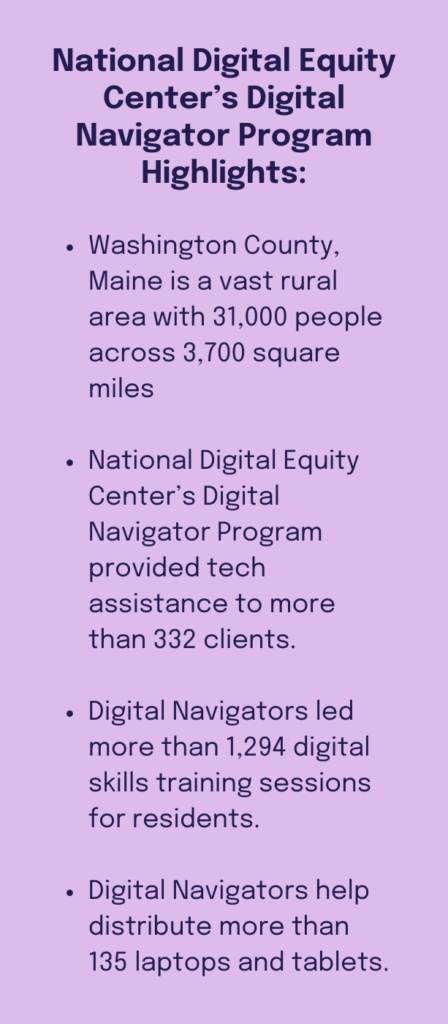
But the Washington County Digital Navigators’ role is more than teaching technology, it’s building trust and addressing the unique needs of this rural community. Partnering with trusted, local organizations is essential for reaching people where they live and giving them tools they can use immediately. NDEC Digital Navigators also partner with two Tribal communities in Washington County to provide digital skills training programs. Ivan Zizek is the Digital Navigator who works with a select group of Tribal residents, providing digital skills needed to assist their community with technical support issues.
Digital Navigators also teach computer basics to residents who receive refurbished laptops and tablets from NDEC through a Maine refurbishing organization – Give IT Get IT – which provides these devices. Since each person’s familiarity with technology is different, Digital Navigators provide one-on-one training sessions tailored to individual learning needs once they receive a laptop.
Proof that even a small lesson can have a big impact involves a woman rebuilding her life after facing setbacks. “She received a refurbished laptop and was trying to track her health data in Microsoft Word but found it too cumbersome. I showed her how to use Excel to set up a simple chart. She quickly picked it up, and called me a few days later, thrilled with her new skill,” shares Rachel. By learning to use Excel, she made tracking her health data easier and felt more confident tackling other digital tasks.
That wasn’t the only simple lesson that gave a client more confidence. Washington County Digital Navigators teach community members to spot internet scams and navigate online shopping, a helpful skill in a remote area where retail options are limited. They’ve empowered older adults to use telehealth platforms, access government services, and connect with family members online.
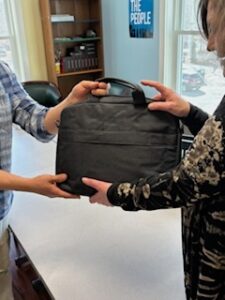
Another example of NDEC’s Digital Navigators’ work in Washington County highlights a partnership with two nonprofits—one serving migrant farm workers who speak English as a second language, Mano en Mano, and another providing devices to these residents, Sunrise County Economic Council.
Marci Gaglione, a Washington County Digital Navigator, collaborates with one of NDEC’s multilingual instructors to support French- and Spanish-speaking residents over Zoom. Together, they create individual learning plans, determine the best device for each person’s needs, coordinate device distribution, and enroll participants in internet safety and device-specific classes—all conducted in their native language.
Through NDEC’s Maine Digital Inclusion Initiative, Washington County residents are becoming more digital savvy, not only learning new skills but also gaining confidence in their ability to adapt to a world that increasingly relies on technology. The Digital Navigators’ impact goes beyond digital skills; it fosters self-reliance and creates connections in a community that often feels isolated.
Digital Navigators are making a difference one skill, one device, and one person at a time. In Washington County, residents are discovering that it’s never too late to learn, grow, and engage with the world. With each lesson, they’re not only overcoming the digital divide—they’re finding new ways to connect and thrive in the digital age.
Increasing Access, Affordability, and Adoption for Washington County Residents
- Build confidence with a personalized approach. Personalized learning plans teaching computer basics are used, enabling the person to advance at their own pace.
- Leverage resources of partner organizations. Older populations are eager to learn about technology and embrace it with the right resources to learn. Digital navigators have access to NDEC’s 45 core classes to build individual digital literacy programs.
- Use trusted site locations. Using trusted community partners – schools, libraries, and senior centers – as site locations for skills workshops and individual classes reaches people where they live.