“The difference between opportunity and frustration often comes down to a simple digital connection,” said Abby Russell.
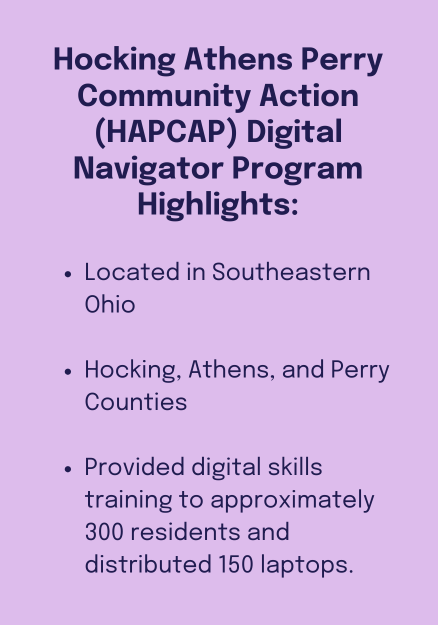
Abby serves as the digital navigator for Hocking Athens Perry Community Action (HAPCAP), an organization selected by NDIA to develop a National Digital Navigator Corps program. Along with support from a Google.org grant, the hiring of community-based resources in rural areas like Abby is possible. In Appalachian Southeast Ohio, where broadband access is often sparse, and computer skills are critical, Abby spends her days helping residents become more familiar with technology and enhance their digital skills. Abby’s work reshapes how residents can connect to resources, family, essential services, and opportunities.
Here, reliable internet can be hard to find and often expensive. Simply getting online is a significant hurdle, and many county services require online accounts to access benefits.
As a community-based resource, Abby is here to help.
She teaches residents how to access the internet and develop fundamental digital skills, such as setting up an email account and navigating online forms.
Abby recalls one of her most memorable clients, a foster parent who didn’t have computers at home for the school-aged children in her care. The school sent Chromebooks home, but they often got damaged in transit. Replacing them wasn’t feasible. After reaching out to HAPCAP for assistance, this parent received a refurbished computer and, with Abby’s help, ensured their at-home learning was a success. The community support made all the difference for this family, which was later honored with the distinction of “Foster Parents of the Year” in their community. Abby’s impact reached beyond technical assistance—supporting a family’s journey to stability and opportunity.
Her role is critical in a place where residents turn to each other as resources. As she puts it, “In our rural communities, people tend to rely on those they know and trust.” Abby’s approach is simple: she physically and digitally meets clients where they are. This often means meeting at one of the public libraries in Hocking, Athens, or Perry County, where a trip to the local county library may be the only option to access a computer.
Abby saw the need for basic computer skills during the pandemic when doctor appointments shifted online. She worked in a local medical office then, and many patients needed to learn how to access online video services, create an account, or log on to access the patient portal. These stories are all too frequent in Southeastern Ohio.

One-on-one Digital Navigator session with a community member.
Since the start of HAPCAP’s digital navigator program in 2022, Abby has partnered with local libraries, schools, job and family service programs, and organizations like the Survivor Advocacy Outreach Program to ensure people are aware of her services. She has taught workshops to help survivors of domestic abuse gain digital skills, connect devices, and access essential services.
The level of technical help or digital guidance varies between school-aged children, parents, and seniors. Abby’s day-to-day involves a wide range of support, from helping set up new devices and learning basic computer skills to preparing for job interviews on platforms like Zoom and teaching parents how to keep their kids safe online. She works with senior centers to host cybersecurity workshops on avoiding scams and preventing fraud.
HAPCAP works with partners like PCs for People to source refurbished devices and turns to Abby to teach digital readiness. She holds ‘giveaway classes’ where clients can keep the laptop only after completing the workshop. This hands-on training builds skills and confidence for a region where resources are stretched thin.
HAPCAP also provides support for people newly released from the jail system. Abby worked with a man who was recently released and enrolled in a re-entry program. He lacked reliable transportation to attend mandatory classes, so Abby gave him a laptop and instructions on how to use it. Although he had some computer experience, he was unfamiliar with new technology and wanted to learn how to use Zoom for job interviews. Abby taught him how to use Zoom and enrolled him in Northstar Digital Literacy training courses to update his computer skills and boost his confidence. He now feels more hopeful that his new digital skills will lead to more job opportunities.
Given limited resources, even businesses need more experience with technology. Abby recently helped a local flea market vendor set up mobile payment options, showing how tools like Square or PayPal can simplify transactions. These skills open doors for local businesses, enabling them to grow and operate more efficiently.
Abby is also keenly aware of the personal impact of her work. “Helping people connect to their families, find jobs, or even stay on top of their health—it all pays off. Every day is a good day,” she says. Whether she’s helping a parent navigate their child’s school portal or a grandparent use video to call a family member, she’s not only teaching skills; she’s expanding what people believe is possible in their lives.
Abby had another fulfilling experience when she went above and beyond her technical support role. An incoming call from an older veteran was transferred to Abby accidentally. He was trying to get information about a local meals-on-wheels program because he lived alone, didn’t have family close by, and couldn’t drive to the grocery store. During their conversation, he asked Abby about grocery delivery. Abby patiently explained Instacart to him, helped him download and navigate the app, and showed him how to find food, order, pay, schedule delivery, and reorder. Abby’s resourcefulness and patience equipped him with new skills that helped him maintain his independence and made his life a bit easier.
Abby wishes to add more digital navigators to HAPCAP to serve the increasing number of people seeking help and provide skills that could help reshape the region.
In her role, Abby is transforming more than just how people use technology; she’s helping residents of Hocking, Athens, and Perry Counties envision a future where digital skills are a given, not a barrier. And in an area that’s long needed a way to bridge the gap between isolation and opportunity, Abby’s work offers more than digital access—it offers hope.
Increasing Access, Affordability, and Adoption for Hocking, Athens, Perry County Residents
- Helping residents access essential services. Abby has helped community members with their online application process for county assistance programs and accessing benefits.
- Creating new opportunities. Through HAPCAP’s support of helping people newly released from the jail system re-enter society, Abby’s digital skills training teaches computer basics and internet navigation to help with employment opportunities.
- Expanding community reach. Abby looks for any opportunity to partner with a community organization or attend a local event to reach more county residents. While attending a Gardening Expo, she taught several farmers how to place online orders for their agri-business. This simple task will save them countless hours, allowing them to make better use of their valuable time in the field.
This blog was written in collaboration with Raynor Avenue Public Affairs.