What happens when a lifelong Hoopa Valley community member combines his passion for helping others with his tech know-how? The digital divides in his community begin to close. Meet Abraham “Abe” Camez, a digital navigator. For years, Abe has been a trusted figure in Hoopa, and now he’s connecting homes to the internet and empowering his neighbors with the skills they need to thrive online.
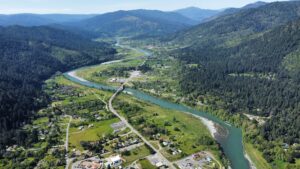
The Hoopa Valley Reservation, spanning over 102,000 acres in Humboldt County, California, is the largest Indian reservation in the state. The Hoopa people proudly maintain their traditions and strong Tribal identity, carrying forward a deep connection to their homeland. But as the world becomes increasingly digital, the 3,500 Hoopa Valley residents face challenges that make it hard to stay connected—both to each other and beyond their Tribal land.
Living in rural California, the residents of Hoopa Valley have long struggled with a lack of reliable internet and technology. The community’s remote location and dense Douglas Fir trees create a complex infrastructure environment, leaving many without sufficient access to the internet. The area is also prone to wildfires during the summer months, which makes reliable connectivity throughout the reservation particularly critical.
Following federal funding programs that became available to Tribal lands during the pandemic, the Hoopa Valley Public Utilities District (HVPUD) took on broadband initiatives to bring affordable, reliable connectivity to Hoopa Valley. HVPUD first created Acorn Wireless, a Tribally-owned and operated internet service provider that provides 200 households with internet service today. While some homes have been able to access fixed wireless services, the reality is that the community continues to be deeply affected by the digital divide.

By leveraging federal funding from the Tribal Broadband Connectivity Program (TBCP), HVPUD hopes to significantly improve internet infrastructure on the reservation, aiming to provide equitable access to high-speed broadband for residents and businesses through initiatives focused on digital equity; this includes building out fiber optic networks and expanding wireless coverage across the remote tribal lands. HVPUD launched its new digital navigator program to help residents get online and thrive in the digital world through NDIA’s National Digital Navigator Corps, funded by Google.org in partnership with AMERIND Critical Infrastructure.
Abe – a familiar face in the community – is at the forefront of this effort. Moving to Hoopa at just two years old, Abe has dedicated his life to serving his community in various roles—from law enforcement to pandemic response. Now, as Hoopa Valley’s digital navigator, Abe is helping residents bridge the technology gap and equipping them with essential digital skills.
What makes this program so impactful is its community-first approach. Abe has made it his mission to ensure that everyone, especially Hupa Elders, feels comfortable using technology. Whether it’s showing someone how to navigate the web, teaching them to use Google Docs, or walking them through the basics of Microsoft Office, Abe is there to guide them every step of the way.
“I’ve been working with my community for years,” Abe shares. “So I know how important it is to have someone you trust help you through something that feels new and overwhelming.”
In the program’s early days, one of Abe’s most significant accomplishments was helping nearly 100 Hoopa residents enroll in the federal Affordable Connectivity Program (ACP), which gave households discounted internet service. While the ACP has since expired, those efforts helped many families get online for the first time, making a real difference in their daily lives. Now, Abe has shifted his focus to building digital skills and expanding opportunities for residents through programs like the “learn to earn” initiative, where residents receive a computer device after completing digital skills training.
Through this initiative, Abe uses the local library—one of the few public places in Hoopa Valley with consistent internet access—to teach residents critical tech skills. After completing a series of lessons, participants earn a certificate and are given an iPad, thanks to a partnership with the school district. “We’ve had people of all ages come through the program,” Abe says. “One of the most memorable moments was when an Elder came in with her son and daughter to take the class together. It really showed how technology can bring generations together.”
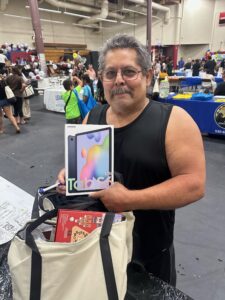
Recipient of a Samsung tablet at a community health fair event.
Abe’s work continues beyond the library. He’s also regularly out in the field, riding along with the technicians from Acorn Wireless. During installation appointments, Abe introduces himself to residents and offers help setting up routers, finding affordable streaming services, and explaining how to navigate their new digital tools.
“My goal is to meet people where they are—literally and figuratively,” Abe explains. “When I’m at their homes, I get to see what they need firsthand and provide personalized help on the spot.”
Despite his efforts, the challenges of spreading the word about the program remain. Hoopa Valley is a large, rural area with limited connectivity, and reaching everyone takes time. Abe has been getting creative with his outreach, using Facebook posts, flyers, and newspaper articles to inform people about his services. He regularly attends local health fairs and events at the K’ima Medical Center, talking to residents about the digital skills programs available to them.
There’s progress, but Abe knows there’s more work to do. As Hoopa Valley’s broadband infrastructure improves and the fiber build is completed in the coming years, Abe expects even more residents will seek out his services. “Right now, not everyone has internet access, so digital training isn’t always a top priority,” he explains. “But as connectivity increases, people are going to need help navigating it—and this program will be equipped to do that.”
In the meantime, Abe continues focusing on what he does best—supporting his community with patience, understanding, and practical solutions. Through partnerships with schools, libraries, and local organizations, Abe ensures that Hoopa Valley is not left behind in the digital age.
The digital navigator program recently expanded to a neighboring community just south of Hoopa Valley. Abe helped set up a small computer lab at the Willow Creek Community Resource Center to make space for several computer stations. Community residents can access the internet and turn to Abe for help with essential device support or attend a digital literacy skills training class through Northstar’s certification program.
“We’ve made a lot of progress, but there’s still so much potential,” Abe says. “The more people we can get online, the more opportunities we can create for everyone here in Hoopa.”
With Abe’s leadership and the continued efforts of the digital navigator program, Hoopa Valley is setting the stage for a future where every resident can fully engage in the digital world—one connection at a time.
Increasing Access, Affordability, and Adoption in Hoopa Valley
- Helping residents know the various connectivity options available to them. As an Acorn Wireless employee, Abe is well-versed in helping community members with connectivity options and offers onsite technical assistance during technician service appointments.
- Access to devices. Nearly 100 residents previously enrolled in the Affordable Connectivity Program received Samsung Galaxy Tablets. Twenty tablets were distributed at community outreach events, and thirty-one iPads were given out through a recently launched learn-to-earn program utilizing NorthStar Digital Literacy Skills Training.
- Expanding the reach of the digital navigator program. Creating programs to build digital skills like the “frequent flyer” program, which encourages Tribal elders to return for follow-up help with the digital navigator.
- Accessing community resources. Leveraging community sites with high foot traffic ensures residents have access to consistent and reliable resources where they can learn at their own pace. Abe promotes his regular drop-in office hours at Hoopa Valley’s local library on social media pages, flyers, and the local Tribal radio station. At the Willow Creek Community Resource Center, Abe hosts drop-in hours weekly and hopes to set up two new computer stations.
This blog was written in collaboration with Raynor Avenue Public Affairs.