“Thank you for helping people like us answer some very basic questions—most of the time we have to pay people to do this for us,” said one grateful library patron after meeting with a digital navigator.
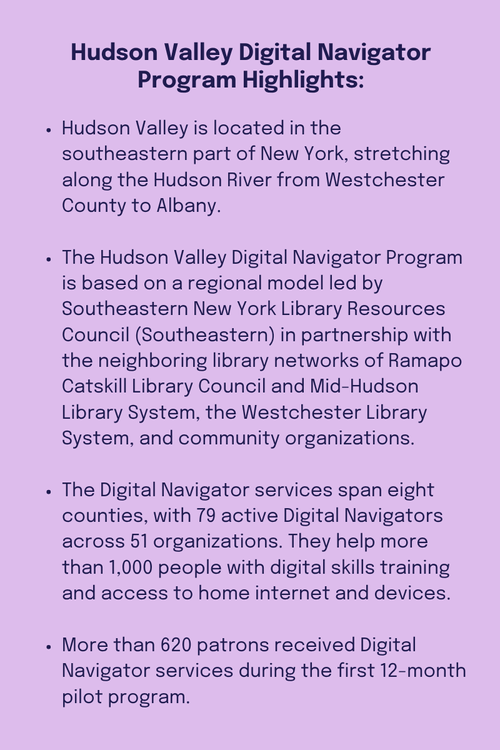
Across New York’s Hudson Valley, libraries are doing far more than lending books—they’re helping people navigate job applications, communicate with loved ones, and participate in everyday digital life. That’s the power of the digital navigators of the Hudson Valley program, a regional initiative led by Southeastern New York Library Resources Council (Southeastern) in partnership with the Mid-Hudson Library System, Ramapo Catskill Library System and the Westchester Library System. The program trains library staff and other community-based professionals to become trusted guides—digital navigators—who help local residents tackle a wide range of tech-related needs, from printing to password recovery to applying for a job online.
Beginning in 2022 with funding from the federal American Rescue Plan Act (ARPA), the program’s strength comes from its regional design. By working across four library systems and nine counties, and supporting over 50 organizations—including libraries and community groups—it has built a powerful ecosystem of support for residents seeking to build digital confidence.
At the center of this effort is a training and support model powered by consulting services with NDIA, whose role has been foundational: providing curriculum and helping to foster a community of practice among the region’s digital navigators. NDIA leads a three-day training series focusing on digital equity, technical tools, and program operations like data collection and community engagement.
Each digital navigator commits to supporting at least five clients over three months, participating in a cohort-based peer learning network along the way. Cohort meetings, listserv conversations, and mentorships led by NDIA team members provide ongoing support, ensuring that even new navigators can confidently meet community needs.
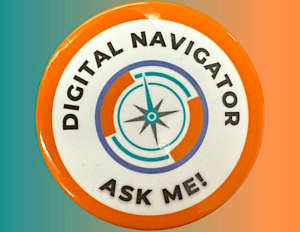
Easy signage and branding also helps. With “Ask Me About Digital Help” buttons and banners in participating libraries, patrons know whom to approach—and often strike up a conversation that leads to lasting support.
“There’s so much trust already built in libraries,” said Carolyn Bennett Glauda, project manager for Southeastern’s digital navigator program. “For many people, asking for help can be intimidating. But when they see a librarian or navigator offering support, that wall comes down.”
More than 1,000 residents have been helped by digital navigators in the region, often teaching tech skills essential to daily tasks. But the stories are powerful.
- One patron learned how to email attachments for the first time—essential for keeping up with housing paperwork.
- One stroke survivor worked with a navigator to relearn computer basics, later sharing, “I’m just so satisfied to be a part of the digital community again.”
- A shelter resident learned how to upload documents and send emails. He enrolled in college and started classes that fall.
- A woman wanted to share photos of baby birds with her daughter in England. A digital navigator helped her attach and send the images—something she never thought she’d do on her own.
The program has grown not just in reach but also in depth. A mentorship model developed by Southeastern pairs experienced digital navigators with new trainees, ensuring skill-building through shadowing and feedback. Some participants have gone through multiple three-month terms, continuing to support their communities beyond the original training. Libraries participating in the program receive a modest stipend as an incentive for staff time and documentation, recognizing the real commitment it takes to make digital navigation successful.
One key innovation has been the 3-month cohort model. In a region where library staffing can be in flux, this approach keeps the bar attainable: participants receive training, meet with at least five clients, and submit interaction data over a three-month period.
“Three months is the sweet spot,” said Tessa Killian, Executive Director of Southeastern. “It allows us to train new navigators, keep up with library staff turnover, and ensure a steady pipeline of support for the community.”
The rolling cohort system allows new digital navigators to join at any time while sustaining services over the long term. In 2025, the team launched a “Digital Navigator Lite” program for those already trained, offering continuing support without requiring retraining.
Digital navigators are already embedded in 79 locations. In places like Mountain Top Public Library in Tannersville, where spotty internet service is a daily reality, digital navigators help residents access essential services like healthcare and job portals. In Newburgh, where urban poverty limits access to devices and connectivity, library patrons rely on digital navigators to complete homework, apply for jobs, or learn how to use basic programs. At one site, a resident needed help printing out a New York State form. At another, someone learned to shop safely online. The range of needs may vary, but the impact is consistent.
As the program looks ahead, it’s exploring ways to extend beyond libraries to scale their efforts, inviting housing authorities and municipalities, senior centers, and other community organizations to bring digital navigator services into more neighborhoods. That vision reflects the heart of the initiative: meeting people where they are, using trusted institutions, and delivering human-centered digital support.
As Tessa puts it: “Librarians are the most trusted profession beyond nurses. For a digital navigator, establishing rapport is everything—and librarians have already done that.”
In the Hudson Valley, digital equity isn’t just a concept. It’s a practice, carried out one person, one question, and one connection at a time.
Increasing Access, Affordability and Adoption Across Hudson Valley:
- Creating a Sustainable Digital Navigator Program. To increase the number of trainers, Southeastern is piloting a “Digital Navigator Lite” program this year. This program utilizes individuals who have either previously completed the Digital Navigator Hudson Valley training and 3-month cycle, are active DN cohort members, or possess equivalent skills from other community-based organizations. Participants in the Digital Navigator Lite program will receive support through a community of practice, including access to the listserv, office hours, promotional marketing materials, and professional support.
- Train the Trainer Model. This model focuses on strengthening the skills and expertise of the trainers. By providing access to professional development resources and training from NDIA’s consulting services, trainers gain the confidence and knowledge they need to assist others with technology-related questions effectively. Additionally, Southeastern has established a mentorship program, selecting 12 of the most active librarians, identified through a focus group, to mentor other trainers and teach best practices from model library DN programs.
For more information about NDIA’s consulting services, contact us.