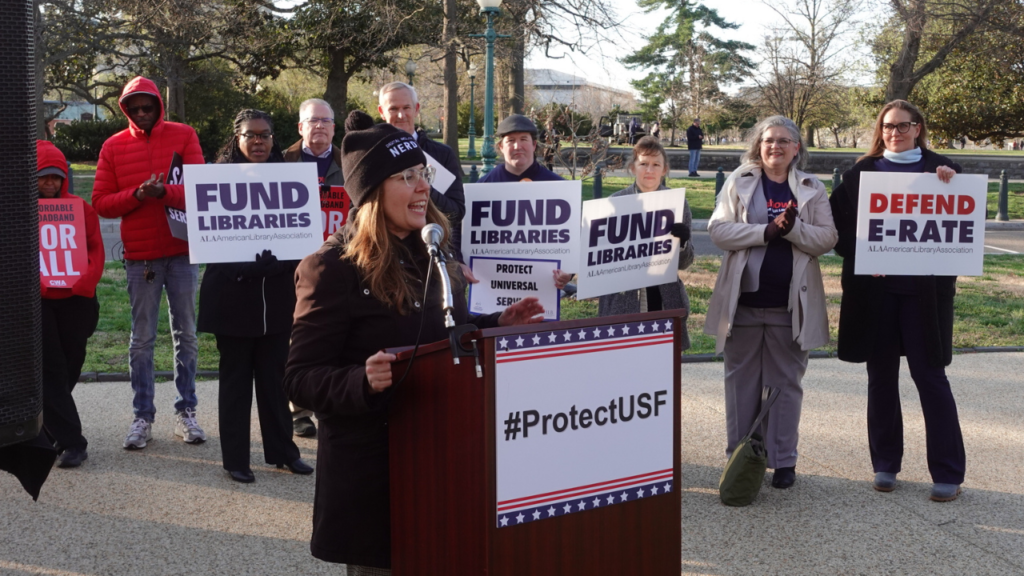
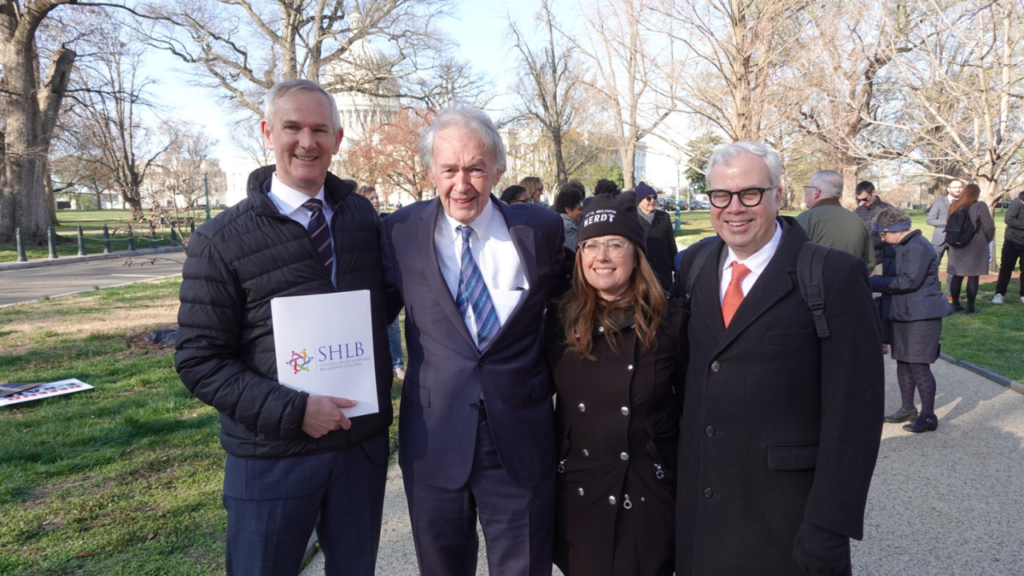
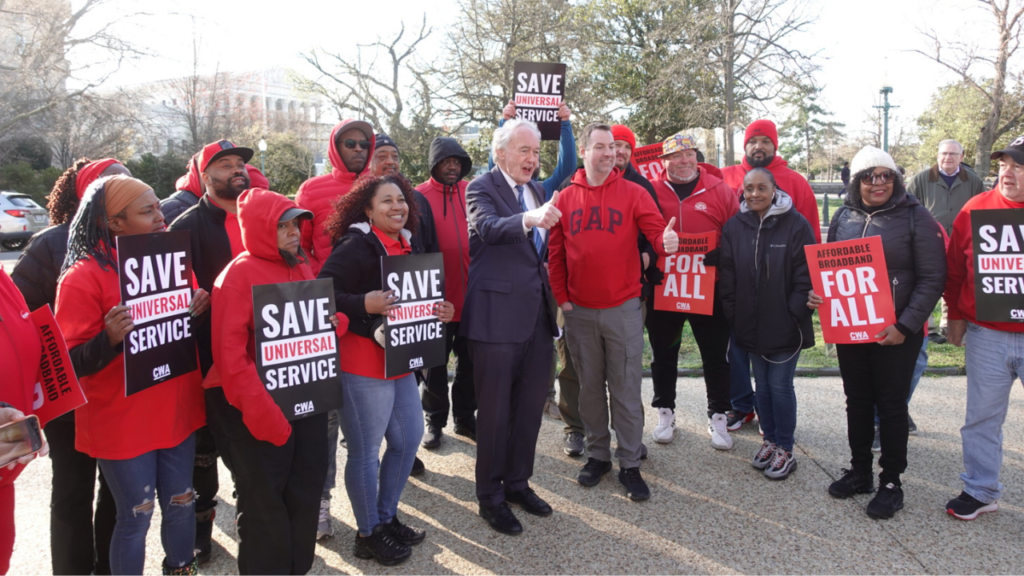
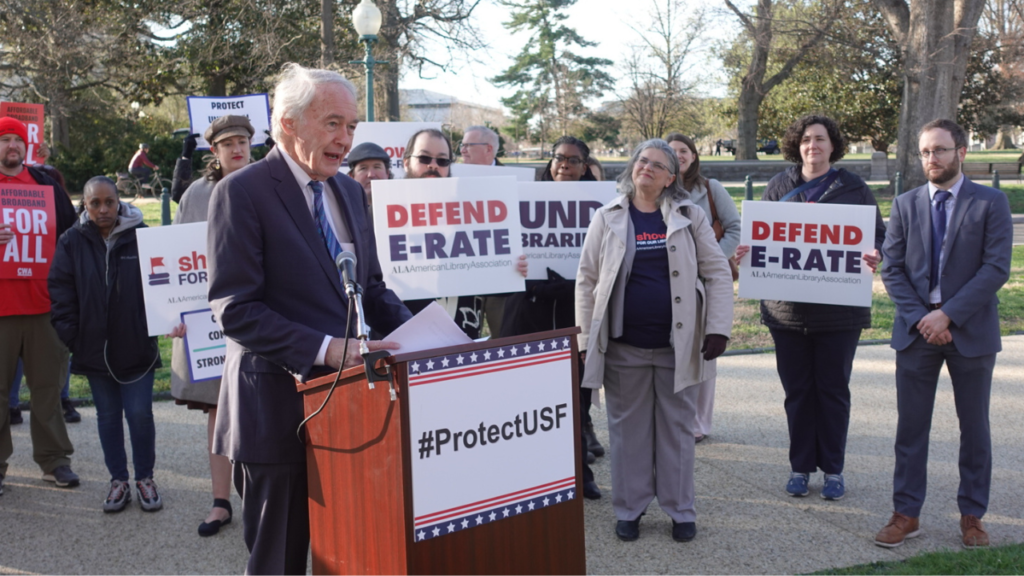
Yesterday, the U.S. Supreme Court heard oral arguments in “FCC v. Consumers’ Research,” the case that could determine the future of the Universal Service Fund (USF). Before the arguments, Keep Our Communities Connected held a press conference with Senator Edward Markey, joined by members of the Lifeline Coalition (Benton Institute for Broadband & Society, Media Justice, Schools, Health & Libraries Broadband (SHLB) Coalition, and NDIA), teachers, doctors, rural healthcare workers, and other community members to advocate for the preservation of USF.
The Supreme Court seems likely to preserve the $8 billion a year the government spends to subsidize phone and internet services in schools, libraries, and rural areas. The justices heard nearly three hours of arguments in a new test of federal regulatory power, reviewing a previous ruling that labeled the Universal Service Fund as unconstitutional.
Earlier this year, NDIA and other members s of the Lifeline Coalition filed a brief with the U.S. Supreme Court calling on the court to preserve USF.
The Federal Communications Commission (FCC) manages and sets policies for USF and its programs to support the achievement of the “Universal Service” principle—that all Americans should have access to communications service —as Congress outlined in the Communications Act of 1934. The USF aims to ensure this universal service is achieved and does so via four main programs:
- Lifeline – Discount to low-income households for telephone and internet
- E-Rate – Discounted internet access for schools and libraries
- High Cost – Subsidizes internet service providers (ISPs)in rural areas
- Rural Health Care – Discounts internet service for rural health care providers. The fund sustains these programs by collecting fees from providers who provide interstate, long-distance services.
“NDIA’s 2000+ affiliates work tirelessly to ensure their community members can apply for jobs, take classes from home, talk to their doctors virtually, and stay connected with their loved ones. Without the USF, more residents will be left on the wrong side of the digital divide, reducing the US’ ability to compete in a global economy,” says Amy Huffman, Policy Director for NDIA.
Both liberal and conservative justices expressed concerns about the potentially devastating consequences of eliminating the fund that has benefited tens of millions of Americans, mirroring the sentiments of those who showed up and spoke up to advocate for the preservation of USF.
“We’re here to stand up for the millions of Americans who rely on affordable high-speed internet to learn, to work, to receive healthcare, and to stay connected. The Universal Service Fund is the cornerstone of digital opportunity and has been for decades … We will not stop working, we will not stop fighting, and we will not stop organizing because no comm should be left behind.”
Joseph Wender, Executive Director, SHLB Coalition
“Access to education shouldn’t depend upon your zip code. Every child in every classroom in every community, urban or rural, rich or poor, deserves access to the internet. That is a right; it is not a privilege.”
Senator Edward Markey (MA)
“Being online is no longer a choice. It is actually a luxury to take a break from the internet—a break that would require planning. Pay your bills, request a prescription refill, submit a class assignment—we all know to-do lists like this. Yet, millions of Americans still cannot be online when they need to be. NDIA is an intervenor in this case because safely getting and staying online is absolutely essential today. Nobody disagrees with the end result – we all want a country where students can keep up, veterans can get healthcare, and small businesses can reach people online.”
Angela Siefer, Executive Director, NDIA
The Supreme Court decision that could affect the future of USF is expected by late June 2025.