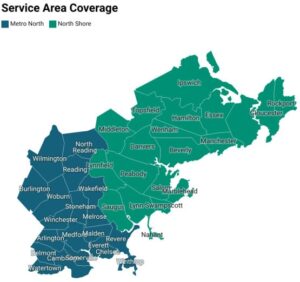
“Digital equity is about more than just internet access—it’s about opportunity,” says one of the community-based digital navigators serving the Metro North and North Shore regions of Massachusetts. From Cambridge to the New Hampshire border, a growing team of digital navigators is transforming how residents connect, learn, and move toward meaningful careers.
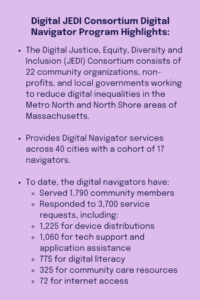
Launched in 2024 by the MassHire Metro North Workforce Board and powered by a grant from the Massachusetts Broadband Institute (MBI), the Digital Justice, Equity, Diversity, and Inclusion (JEDI) Consortium is bringing together 22 community partner organizations across 40 cities and towns to close the digital divide—and open pathways to economic mobility.
What makes the Digital JEDI Consortium unique isn’t just its scale. It’s the program’s commitment to a workforce-centered model—one that supports both the communities being served and the individuals delivering the services.
A Regional Model with Deep Community Roots
Each of the partner organizations plays a specific role: some focus on outreach, others on training, and several serve as host sites for digital navigators. What unites them all is a shared vision: ensuring that underserved communities have access to devices, digital literacy, and reliable tech support.
Many of these organizations are already trusted community institutions—local libraries, housing authorities, and community centers—making it easier for digital navigators to meet residents where they frequent, whether at senior centers, public housing units, or multilingual events.
The digital navigators themselves reflect the diversity of the region. Many are bilingual and bring a range of backgrounds in IT, healthcare, and education. All are deeply rooted in the communities they serve. One Digital Navigator teaches Spanish-speaking seniors how to use smart TVs at a community center in Revere. Another helps residents navigate public benefit portals and housing assistance forms at a neighborhood nonprofit.
A Workforce Pipeline for Digital Navigators
From the beginning, the Digital JEDI Consortium was designed as a workforce pipeline. Digital navigators aren’t just temporary workers—they’re gaining real skills and on-the-ground experience that can launch careers in IT, cybersecurity, community health, and digital services.
Each Digital Navigator receives training through a combination of NDIA’s Digital Navigator curriculum—which covers digital equity, client communication, and soft skills—and technical training through the Massachusetts Association for Computer and Internet Resources (MACIR), including IT basics, device setup, and a help desk-style ticketing system to track service requests. Additionally, digital navigators are working towards a Google IT Support Professional Certificate through MACIR.
MACIR also facilitates weekly peer-sharing sessions, where digital navigators exchange ideas, troubleshoot common issues, and offer support to one another. NDIA continues to provide professional development opportunities through its consulting services, with training on topics like boundary setting, teaching resilience, and building client trust.
The impact is already being felt in powerful ways across the region.
At Cambridge Community TV, staff shared that many visitors had never stepped through their doors before the program. “It’s been heartwarming to see how the digital navigators meet the community in a helpful, efficient, and compassionate way,” one staff member said. “People are coming in just from word of mouth. That tells us it’s working.”
Among those new visitors was a South African immigrant who received a laptop and began taking courses and applying for jobs. Another was an unhoused community member using their device to enroll in continuing education. An Afghani woman—a former educator—used her program-provided laptop to gain new credentials and pursue better job opportunities in the U.S.
At Just-A-Start, a young woman training for a biomedical career struggled to stay on top of her coursework due to housing instability and unreliable internet. A Digital Navigator helped her apply for a mobile hotspot through the Digital JEDI Consortium’s program. With consistent connectivity, she was able to stay engaged and succeed in her training.
In Chelsea, La Colaborativa helped a mother re-enter the workforce after a job loss. She attended workshops on online job platforms, developed new tech skills, and regained her confidence. She now works at a local school, giving her both financial stability and more time with her children.
And five students who completed an intermediate digital literacy course at Somerville Community Corporation used their new laptops and skills to enroll in college. Three are now pursuing degrees at Bunker Hill and Roxbury Community Colleges.
Building a Sustainable, Replicable Model
The Digital JEDI Consortium’s decentralized, partner-led approach proves that scaling digital inclusion is not only possible—it’s sustainable. Each organization tailors its services to local needs while staying connected through shared infrastructure and ongoing support from NDIA and MACIR.
All of this helps bridge the gap between residents and the tools they need to thrive. One of the key tenets of the program is recognizing the expertise of the community organizations and providing them the support they need so they can provide services tailored to their communities’ needs.
It’s about creating pathways: for residents using a laptop for the first time, for parents navigating online resources for their children, and for digital navigators building careers as they help their neighbors succeed.
As the Digital JEDI Consortium grows, the vision is clear: expand into more communities, deepen investment in training, and keep digital justice at the heart of economic opportunity.
With support from MBI, NDIA, and a growing network of local partners, the Digital JEDI Consortium is showing what’s possible when communities lead the way. For more information about NDIA’s consulting services, contact us.
Increasing Access, Affordability and Adoption for Metro North and North Shore Massachusetts:
- Raising Awareness of Digital Navigator Services: digital navigators promote the program through their host organizations’ message boards, newsletters, and other trusted community channels. Many also host digital skills workshops and classes at community hubs like libraries and civic centers to increase visibility and engagement.
- Expanding Access to Devices: By pairing device distributions with digital skills training, residents receive the tools they need while also learning how to use them. Eligible community members can request a refurbished Windows laptop with MS Office for workforce development opportunities. Those who aren’t eligible are linked to existing device distribution services such as Tech Goes Home, a program that offers a Chromebook to participants who complete the course, ensuring meaningful access from the start.
- Community-focused training: Classes are offered in both English and Spanish and emphasize high-demand tech skills such as web development, UI/UX design, and Microsoft Office programs. Through a partnership with MACIR, qualified residents receive high-quality refurbished laptops and mobile hotspots, allowing them to put their new skills into practice immediately.