Mark Revolinski knows a thing or two about technology. After retiring from thirty-eight years in the telecommunications industry, he and his wife relocated from Wisconsin to Texas to be closer to his grandchildren. As a young retiree, Mark wanted to use his talents to give back, and while determining his next move, his wife saw a social media post from the Pottsboro Library in search of a digital navigator for their pilot program. He enjoyed the role so much that when the Pottsboro Library received a grant in 2022 from Google.org as part of NDIA’s National Digital Navigator Corps program, he decided to stay on as their full-time Digital Navigator. “It takes a special person to fill these shoes,” he said. “As 80% social work and 20% technology teaching – it’s certainly rewarding.”
Mark visits assisted living centers in his role, as the area has a high elderly population. Every other Thursday, he hosts ‘Technology with Mark’ at different facilities throughout the Pottsboro area. Residents ask for his help with small things like turning their “ringer’ on their phone to hear phone calls and text messages or help with their iPads. As Mark is quick to point out, he’s helping people who did not grow up with technology become more familiar using it. These individuals are who Mark finds most rewarding to assist. “It’s not only just solving their technology problems, but also sitting down and taking the opportunity to know them personally.” For Mark, spending time with them is a pleasure he doesn’t take for granted.
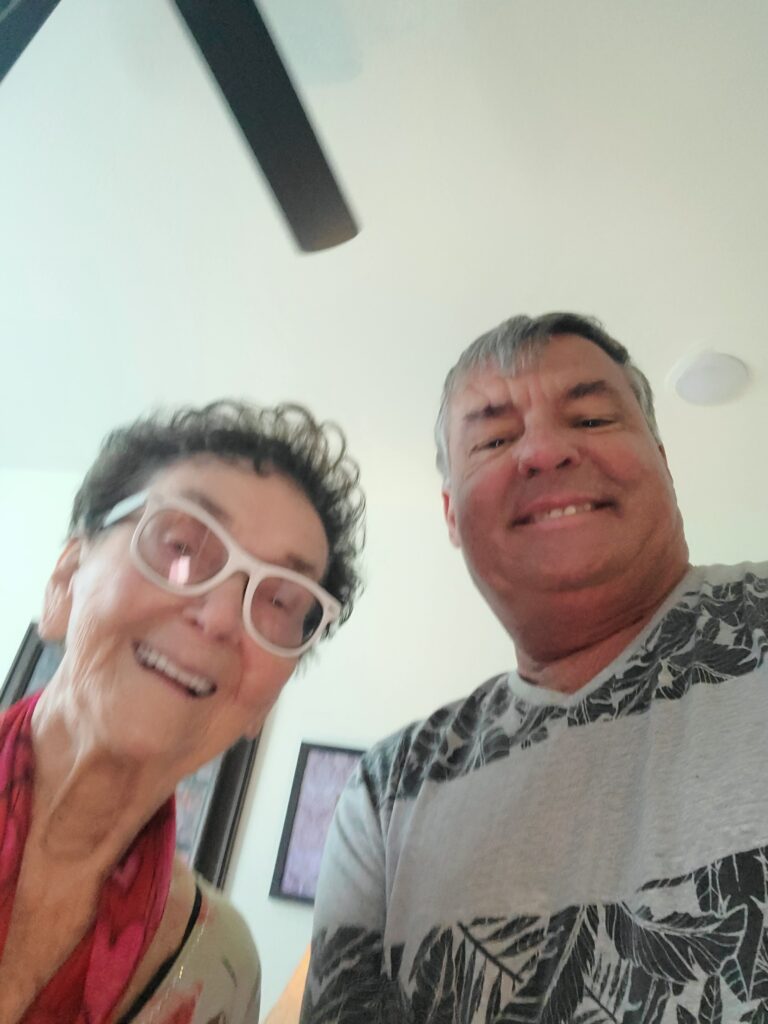
One of Mark’s favorite success stories is when a woman at an assisted living facility who had recently lost her husband asked Mark for help. She could not get her Google Assistant to work properly, and because the account was set up in her husband’s name, it would not respond to her voice commands. For Mark, the solution wasn’t that difficult. He said to her, “Sharon, your Google is ready.” She immediately replied, “Hey Google, play Elvis – I’ve waited three months to do that.”
Mark’s work is a testament to the innovation and support from the Pottsboro Library. The library, which has focused on digital equity since 2016, has worked to boost broadband access, enhance patrons’ technological skills development, and improve access to devices for those in need. Dianne Connery, the library’s Development Director, learned early on the disparity that exists between the haves and have-nots in a rural area. She witnessed firsthand the number of people who came to the library just to use the computers for routine everyday tasks. It caught her interest that teens in particular were unfamiliar with basic technological tasks. “How are these kids ever going to be on a level playing field when they get out of high school? If you want to reach your aspirations, you’re gonna need to be tech-savvy,” she said.
When the library received a grant for a digital navigator, Dianne jumped at the opportunity. She hired Mark, and the rest is history. It’s clear speaking to Dianne how proud she is to have Mark leading the library’s digital navigator efforts. “He makes house calls – did he tell you that?,” she’s quick to remark.
When the Pottsboro Library recently faced potential budget cuts, the community showed up at a city council meeting to voice the impact Mark has made through his work at the library. With a packed room, some spilling out into the parking lot, multiple residents stepped up to the microphone to share what the library means to them. And they mentioned the same thing repeatedly—the Digital Navigator Program.
Older adults talked about how the Digital Navigator helped them figure out telehealth appointments, saving them long trips to the doctor. One woman, Jo Ann, got emotional describing how, after her husband recently passed, she’d felt completely disconnected—until the Digital Navigator showed her how to organize her digital photos. She said, “her life would be so much harder without Mark. I would struggle without the help I receive at our library.”
These stories weren’t just heartwarming—they made a difference. City officials listened and saw firsthand that the library isn’t just a place to check out books. It’s where people come to learn, connect, and get the support they need in an increasingly digital world. Thanks to the overwhelming show of support, the funding cuts were stopped, at least for now.
So, what does the future hold for Pottsboro Library’s Digital Navigator program? Hopefully additional growth and evolution. The Texas State Library and Archives Commission will be awarding additional grants through the Digital Equity Act, and Pottsboro is hoping one of them has their name on it to build on the digital navigator program. “We’ve seen the impact it has had on the community,” Dianne said. And as for Mark? He’s committed to remain in place until the conclusion of one of their current grants, and he plans to retire (again). He’ll leave behind big shoes to fill but has abundant faith and pride in the Digital Navigator program he helped mold.
“After establishing a digital navigator program, individuals may not at first comprehend its purpose. Be patient. The program may begin slowly, but once people see the program’s immense value, they’ll start knocking on your door in no time.”
Mark Revolinksi, Digital Navigator
Increasing Access, Affordability, and Adoption Across Grayson County, Texas
- Raising Awareness: Local TV commercials and flyers initially helped spread the word. Because of the grants it’s received, the library can help nonprofit organizations that rely on community donations get up to speed with their technology. In turn, those organizations provide referrals for people to go to Pottsboro Library.
- Building Trusted Relationships: Pottsboro Library is a fixture in the community, not only through its digital navigator program but also through partnerships with organizations like a local multicultural center, where it assists immigrants with technology training, and Family Promise, which helps people transition out of homelessness.
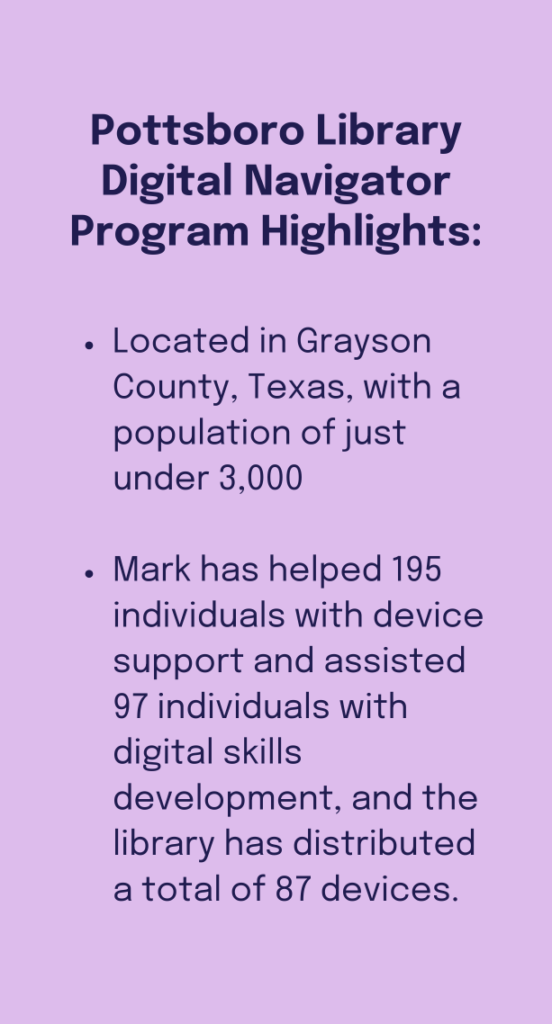
- Access to Technology: Pottsboro Library has distributed a total of 87 devices to residents in need.
- Expanding Connectivity: As a Digital Navigator, Mark has assisted 195 community residents and developed digital skills for 97 residents.
- Accessing Community Resources: The staff at a rural library know the community personally and become nimble enough to address their needs. For example, when schools shut down during the pandemic, a young mother came to the library completely overwhelmed at the prospect of providing education for her kids in her mobile home with no computers and or Internet access. The library staff was able to help connect her home to the Internet and provide technology training so that she could educate her children. She’s since gone on to attend community college.